Tuesday, October 1, 2013

A Funny thing happened to Kevin Nealon on the way to Nebraska

Former SNL cast member Kevin Nealon is coming to Omaha in November performing at the Funny Bone Comedy Club.  It so happens, the very same weekend my cousin - Sheba Mason - will also be performing at the Funny Bone!

That same Shabbos Sheba will be my guest on Good Shabbos Nebraska - America's Favorite Shabbos Morning Talk Show!  Sheba is the daughter of comedian Jackie Mason - who is my grandfather's brother.  

About an hour ago Sheba called me from NYC to tell me the most incredible thing.  She was on line at a Starbucks and - of all people - Kevin Nealon got on line behind her!  She turned around and introduced herself and as they waited for their lattes she told him that they are going to be performing at the same club on the same weekend in Omaha, Nebraska!

It turns out Nealon is a big fan of Jackie Mason (he did his Jackie Mason impression for Sheba) and hopefully they will have a chance to get together in Omaha before his show.  Maybe he will even show up at Beth Israel to check out Good Shabbos Nebraska - America's Favorite Shabbos Morning Talk Show!

What a crazy coincidence!

This Shabbos we have America's Rabbi Shmuley Boteach!  It is going to be a great Shabbos.  But then again at Beth Israel every Shabbos is a shabbaton!

Monday, September 30, 2013

Shmuley, Genocide, and Challenging God

This week is the premier of Good Shabbos Nebraska, our new program at Beth Israel.  Where we dump the pulpit and learn Torah together as a congregation.

As I mentioned in an earlier post, our first guest is America's Rabbi Shmuley Boteach.

In preparation for Shmuley's visit I bought a copy of his new book The Fed-Up Man of Faith: Challenging God in the Face of Tragedy and Suffering.  (The book is on sale for only $10 on his website)

Shmuley addresses the age old question of Why do Bad things happen to Good people?

***Spoiler alert***

Shmuley challenges those who say that God has His reasons and we just have to trust him.  He should not accept that those who are suffering must have done something to deserve that suffering.  Rather,
"do as Job.  Assert your righteousness, hold God accountable, challenge fate, and demand that suffering finally end."
Shmuley is certainly doing his part to end tragedy and suffering in the world.  Just yesterday he held a massive event in New York City with billionaire philanthropists Sheldon Adelson and Michael Steinhart, featuring Elie Weisel and Rwanda President Paul Kagame.  The purpose of the event was to inspire a call to action against the tragedies going on right now in Syria.

Shmuley could not be coming for a more appropriate episode of Good Shabbos Nebraska.  This week, Jews around the world are reading the section of the Torah that talks about Noach and the flood that destroyed the world.  The flood was the first global genocide and it was brought about by God.

Join us as we learn the parshah together and hear from Shmuley what he thinks about this sort of Divine Justice and how the Torah relates to current events.

Good Shabbos Nebraska is every Shabbos morning at 10 am.  Only at Beth Israel Synagogue.  Where every shabbos is a shabbaton!

Sunday, September 29, 2013

Introducing - GOOD SHABBOS NEBRASKA

This week is the premier of GOOD SHABBOS NEBRASKA -American's favorits Shabbos morning talk show.

The city of Omaha has 6,000 Jews of which less than 2% attend synagogue on any given Shabbos morning. That is not a healthy statistic for any Jewish community.  

As I mentioned in a recent op ed for the Omaha Jewish Press, the most authoritative polling institute for religious life is the Pew Research Center.  Without rattling off any statistics, the very fact that they call themselves the PEW center tells us that PEWs - those benches that we have in Synagogues - are a reliable indicator of a communities vitality.  The JEW to PEW ratio in Omaha does not speak well for our community.

I chose the synagogue business as a career path because I have always believed, and continue to believe, that shuls build community.  When people go to shul they become more educated Jews, more passionate Jews, and more caring Jews.

When people don't go to shul their Torah knowledge suffers, they become detached from the needs of the community, and they become apathetic and start to wonder why we need a Jewish community in the first place.  

I love the Omaha Jewish community.  I have dedicated the last ten years of my life to helping strengthen this community, and I believe that this wonderful community has great potential.  But if we are going to ensure the future of our community we need to come back to shul.  

So to meet the needs of our community we are completely revamping our Shabbos morning format and introducing GOOD SHABBOS NEBRASKA!  (check it out at www.goodshabbosnebraska.com)

The pulpit format has had its time.  Today people want a format that talks with them - not at them.  So we are opening up our prime time Shabbos morning slot, and instead of a pulpit - a desk, chairs, and a coffee mug.  Instead of a sermon - an opening monologue.  

And most important instead of the same thing every week - special guests every Shabbos.  Our first guest is going to be America's Rabbi - the one and only - Shmuley Boteach!

Shmuley is the perfect guest for our new initiative.  He is certainly no stranger to the talk show format.  He has been a regular on Oprah and he hosted his own television show -Shalom in the Home - on TLC.  He will definitely make for a great speaker.  

Shmuley is not just coming as a speaker.  Just like on Shalom in the Home Shumley is coming here as a consultant.  He is probably the most creative Rabbi in the world.  Good Shabbos Nebraska is a great concept, but to get it off the ground and change the culture of our community we are going to need the input of someone who know how to create systemic change.  And nobody does that better than Shmuley!

As I write this, Shmuley is sitting with Elie Wiesel and the president of Rwanda running a program in New York City on Genocide that will no doubt inspire tens of thousands of people to take action and try and affect the terrible situation in Syria.  

Shmuley knows how to inspire people to action.  And Omaha's Jewish community needs action!

My modest goal is to see synagogue attendance in Omaha increase to 4% of our Jewish community - a 100% increase - over the next year.  It may not seem like much, but it is a start, and we have to start somewhere.  

So come out every week at 10 am to Beth Israel.  This week Shmuley Boteach, and every subsequent week we are going to have A list guests learning Torah and speaking on contemporary, relevant, and interesting Jewish topics.  Check out the full line up at www.goodshabbosnebraska.com or like our facebook page for regular updates.

Omaha Jews, come back to shul.  Learn the Torah, learn the needs of the community, and understand the uniqueness and importance of being Jewish so we can pass down a substantive and meaningful tradition to our children.

Thursday, September 12, 2013

My Service on erev Yom Kippur

Two years ago on erev Yom Kippur I had the unfortunate merit to perform the greatest mitzvah of all - the burial of a met mitzvah.  The following is an excerpt from my blog from 2011.
Today I also had a funeral.  I do many funerals unfortunately, but not like this.  The woman who died was born in 1937.  She was institutionalized at the age of 5 years old and remained there for the rest of her life.  Yesterday we received a call from an attorney who was placed in charge of her.  The woman died late Wednesday night.  She had no known relatives.  No friends.  Nobody in the world even knew she was there.  I had never heard of or met this woman before and I found that according to whatever instructions were left by her last family member, I as the Rabbi of beth Israel synagogue was responsible for taking care of her burial.  This was a true met mitzva - the greatest of all mitzvot that a person can do.  The Talmud says that if the high priest is going to do the Yom kippur service on the holiest day of the year and  the opportunity arises where he has to perform a burial for a met mitzvah he is supposed to abandon the Yom Kippur service and take care of the met mitzvah.  It is the most important of all mitzvot. 
To bury a met mitzvah is a great mitzvah, but one that you hope you never have to perform.  2011 was my first and last time - until now.

By some incredible coincidence, today I received a call regarding a Jewish man who passed away in his home and has no friends or relatives to speak of.  The funeral will take place tomorrow, erev Yom Kippur, at 3:00 pm at Golden Hill cemetery in Omaha and as of now I think I will be the only person at the funeral.

Tomorrow is a big day for any Rabbi.  I have sermons to finish writing, and unfortunately our great chazzan Ari Dembitzer could not join us for Yom Kippur, so in addition, I will have to prepare the davening as well.

So I can't help feeling like the proverbial Kohein Gadol going to do the avodah and encountering the met mitzvah - again.

But there is another ceremony performed by the Kohein that also comes to mind.  The kohein was involved in the ceremony mentioned in parshat shoftim called the eglah arufah.

If a corpse was found murdered in a field in Israel and the murderer was unknown the elders and the kohanim of the closest city would come out to the scene of the crime and perform a ceremony where they would declare - yadeinu lo shofchu et hadam hazeh - our hands did not spill this blood.
Rashi asks, who would think that the elders and the kohanim had anything to do with the murder?
He answers that if a person passes through a town, the leaders are responsible for that persons well being.  If something happens it was probably because they did not take care of him properly.

A Jewish man in my community died and he did not have a friend in the world.  We are not such a large Jewish community.  How did that happen?  As a Rabbi do I bare some of that responsibility?  Could I have reached out to this man while he was alive?  Are there other people who I could be reaching out to?  Is our community doing all it can for its members?

I don't know.

What I do know is that this is the second time that this happened and both times it happened on erev yom kippur.  I am generally not a superstitious person, but this coincidence has given me much to think about going into the day of judgement.

Yom Kippur is the day where all the Jews come out and go to synagogue.  I urge everyone, look around you this year.  If you see someone who does not look familiar, say hello and introduce yourself.  Maybe there are lonely people who could benefit from coming to shul regularly if only someone would give them a kind word.
I wish everyone a meaningful fast and may Hashem answer all of our prayers.
Next year in Jerusalem.

Monday, July 15, 2013

Zvi Ribak: A Jewish Artist

I was doing some research in the Kripke library for Tisha B'Av and I came across a book about the Jewish artist Zvi Ribak.  I looked him up on Wikipedia and there was no article about him.  The man was not only a great artist, but a Jewish hero in so many different ways.  It was one of the most inspiring biographies I have ever read.  
I was inspired to register as an editor for wikipedia and to write an article about this great man.  I wrote a rough summary of his extraordinary life and hope to periodically update the article once I figure out how to get it up.  I encourage everyone to try and get their hands on this book (not available on amazon.com!  I found it here at Abe Books) and learn more about this incredible artist and this incredible man!

Zvi Ribak (Zhitomer, Ukraine 1910 - Israel 1994) was a Jewish painter. He grew up in Radomsyl in a family of religious Jews. He lived a life of relative leisure until the age of 7 when a pogrom came to his ton and killed 880 people. This was at the beginning of what came to be known as the white terror

After the pogroms his family relocated to Kiev where Ribak, age 8, was already recognized to have extraordinary talent. He was given permission to attend an art studio that housed artists such as Kipnis, Pinchuk, and Reznikov. 

During the winter of 1919 Marc Chagall came to visit and took interest in young Ribak's paintings. He offered to take Ribak with him to Paris, but Ribak's father did not allow him to go. 

At the age of 14 he joined the Bubarikin studio. Ribak was told that he could have his livelihood assured as a painter if he would paint portraits of Soviet leaders. Ribak refused saying that this would be worse than eating pork. 

So he decided to learn another profession to support himself. He applied to study architecture at the Kiev Polytechnic but was rejected because he didn't belong to the proletariat or to the Communist Party. He was similarly rejected from the Leningrad Academy of Art.

 Having no alternative he traveled to Dombas where he found work as an electrician in a coal mine. From there he went to the technological institute in Kharkov where he studied nuclear physics under Lev Davidovich Landau, who later won the Nobel Prize in 1962. 

After he graduated he applied to a higher academy of advanced art in Moscow and he was accepted despite the fact that he was a Jew. After the war broke out with Germany he enlisted in the red army. 
"I didn't even know how to fire a gun, but reports of the horrors being perpetrated by Germans against Jews had reached us. We knew what they had done in Warsaw. I was filled with feelings of vengeance. With all my might I wanted, in my own small way, to stop the annihilation of the Jewish people." 
His father was killed by Nazis in the Kiev Ghetto on Rosh Hashanah 1940. 

Ribak served on the Central front under the Jewish General Tschernikhovsky (I aslso could not find a wikipedia article about him, but he sounds pretty amazing as well).. He took part in the conquest of Prague, Warsaw, and Berlin. He was among the group that captured Hitler's bunker in Berlin. 

He ended the war as a Russian officer and recipient of eight decorations, among them "Hero of Russia", "Cross of Lenin", and the "Cross of Stalin". 

After the war Ribak set up the organization of Jewish artist, survivors of the Holocaust. In 1946 Ribak married Batia Waisman. 

In 1948 Ribak came to Israel, a long time dream fulfilled, and joined the fight for independence. He participated in the battles on the Eastern front near Netanya as a member of a religious company. 

After the war Ribak found employment first as an engineer and later as an architect for the city of Tel Aviv. Despite the cities secular nature, Ribak always maintained a religious lifestyle. In 1952 he met the great Rabbi the Hazon Ish and was persuaded to move to Bnei Brak, then a developing city. For ten years he worked as a city planner in Bnei Brak and today his fingerprints can be seen in every corner of the city. 

He had three sons and a daughter. 

All the years in Israel he never neglected his talent and he painted at every spare moment. Many of his works focus on Jewish subjects from the world that had been destroyed. In 1990 Jay Weinstein from Sotheby's edited a book called ""Zvi Ribak: A Jewish Artist"" Weinstein wrote of Ribak's paintings, "He did not paint the candelabrum, he painted the flame."

Thursday, June 20, 2013

Hadran massechet Eruvin - Introducing The Laser Eruv!


This Friday Daf Yomi will be finishing Massechet Eruvin - according to many, one of the hardest sections of the Babylonian Talmud.  I am proud to say that this is the second time that I have finished Eruvin with Daf Yomi.  The last time was on the 19th of Av in 1998.  

Learning Eruvin this time around was a completely different experience.  Last time I was a Yeshiva student and everything was theoretical.  This time I am a community Rabbi who had the rare privilege of being able to oversee the establishment of an eruv in my community.  (For the epic saga click here.)

As part of my siyum on Massechet Eruvin, I want to introduce a new practical concept that I hope will make a real impact on the contemporary conversation of the laws of Eruvin.

The contemporary eruv is usually made up of a series of telephone wires that form a contiguous perimeter around a community.  The challenge of establishing a community eruv is finding a route that works, and convincing the utilities company to allow the Jewish community to string extra wire spans where there are gaps.  

If the city has telephone poles that meet the requirements - great.  If not, the construction of an eruv is costly and requires long conversations with the electric company, the traffic engineers, a contractor, a licenced electrician, non-Jewish neighbors (unfortunately sometimes Jewish neighbors), and eventually the chief of police or even the mayor.  Ask any community that has built an eruv - or that is trying to build an eruv - they will all tell you that it is not an easy endeavor.  

Welcome to the future:

Introducing - The Laser Eruv!

The concept is simple.  Four poles are erected at the four corners of the perimeter.  Each of the poles has a small system of mirrors set up.  A laser is perched on the top of pole #1.

The laser from pole #1 shoots towards pole #2.  The beam is caught by the mirror on pole #2 and redirected towards pole #3, caught by the mirror on #3 and redirected towards pole #4, where it is redirected towards pole #1 completing the circuit.

No more time-consuming eruv checks.  A few minutes before Shabbat the Rabbi takes out his smart phone, hits his laser eruv app which operates the laser and sets up the eruv.  The mirrors can even have censors that inform the Rabbi whether the beam hit its target or if the mirrors need adjusting.  

The concept is simple enough to understand and there are countless applications that can be added that can make constructing and maintaining an eruv easier, more convenient, and cheaper than ever before.

The question of course is, does the laser eruv meet the requirements of a kosher eruv?

That is the topic that I wish to address.  

Massechet eruvin opens up with the case of a mavoi (מבוי), a type of alleyway that was common in ancient residential neighborhoods.  The sages forbade carrying in a mavoi unless the community sets up either a koreh (קורה)- a cross beam - placed across the entrance of the alleyway - or a lechi (לחי)- a post planted at one side of the entrance of the alleyway.  

Rashi, on the first mishnah of eruvin (2a), explains that the purpose of the beam or the post is because the mavoi may be confused with a public domain and therefore this reminder is needed to clearly identify the alleyway as such so that people should not think that it is permissible to carry in the public domain.  (other say they act as a virtual wall)

Towards the end of the massechet, on page 80b, the gemara has an interesting discussion regarding the acceptability of certain materials for a koreh or a lechi, particularly an asheirah tree - a tree used for a type of idol worship.
Rav Hiyya Bar Ashi ruled: "A lechi may be made from an Aheirah tree.  Rav Shimon Ben Lakish ruled: "A koreh may be made from an Aheirah tree."  The one that permits a koreh all the more so would permit a lechi.  But the one who permits a lechi would [only permit a lechi and] not a koreh because its measurements are considered as if they are crushed (כתותי מכתת שיעוריה)
That means as follows.

A lechi must be a visible marker.  It has a minimum height of 40 inches but there is no minimum for the width or depth.  This is the accepted halachah.  The lechis that we put on telephone poles for our contemporary eruvs (while they are not the same thing as the lechis we are talking about in this case) must be at least 40 inches high but have no requirements for width or depth.  Some contemporary eruvs use strips of reflector tape for lechis even though the tape is practically one dimensional.

A Koreh on the other hand has stricter requirements.  These requirements are discussed in the third mishnah (13b).
The koreh (beam) that they were talking about must be wide enough to hold a [type of brick] of three hand breadths.  It is sufficient if the beam is one hand breadth wide in order to hold the brick.  Rabbi Yehudah ruled that it is sufficient if the beam is wide enough even if it is not strong enough.  If it was made of straw or reeds it is viewed as if it were made of metal.  
According to both opinions the beam used for a koreh must look a minimum width.  The argument is whether the beam must actually be as strong as it looks.  It is questionable if Rabbi Yehuda would extend his ruling of a straw beam to include a laser beam.  Even according to his lenient opinion the beam may still have to have some substance to it, which a laser beam is lacking.

But in the gemara on page 80b Resh Lakish is talking about an asheirah tree.  An Asheirah tree is a special tree that was designated for a particular type of idolatry.  The law is that an Asheirah must be burned.  Rashi explains that since the Asheirah stands to be burned it is as if its measurements are not real measurements.  (Rashi to Eruvin 80b and Sukkah 31b)

In the words of the Soncino edition footnote, "A thing that is condemned to be burned is regarded as burnt, and since it must be burnt it is regarded as non-existent."

The Asheirah tree is there but not there.  You may be looking at what you think is a tree, but in reality it has no measurements.  A lulav must be at least 4 hand breadths.  Your Asheirah branch looks like it is 5 hand breadths - seemingly a perfectly kosher lulav.  But really it is zero hand breadths because it is not really there.    So an asheirah is not kosher for a lulav.

An Asheirah tree is like a hologram.  It appears to be there, but it is really not there. It is not kosher in cases where there are minimum measurements required, but even according to the opinion of Hiyyah Bar Ashi on page 80b, in cases where there are no minimum requirements an asheirah is acceptable.

This is the fascinating halachic concept of the Asheirah: the branch or wood beam whose measurements have been "crushed" to non-existent particles.  It seems clear that the concept of the Asheirah beam could be applied to the laser beam, a "beam" that is there but not really there.  If an Asheirah tree can be used for an eruv, it seems clear that a laser beam would be acceptable as well.

(an interesting further "proof" of the connection between an asheirah and a laser emerged on the second to last page of eruvin (104a).  It is slightly out of scope so I made it into a different post.  Click here.)

But still, it is only the opinion of Resh Lakish that allows us to use an Asheirah for a koreh.  The halachah follows the opinion of Rav Hiyyah Bar Ashi who does not permit its use.

But the telephone wires that make up our contemporary eruvs are not korehs.  If they were, telephone wires would not be acceptable as they do not meet the width requirements of holding a brick from the mishnah on 13b mentioned above..

The contemporary eruv is actually made up of a series of doorways - known in halachah as a tzurat hapetach (צורת הפתח) - a shape of a doorway.

Each telephone pole represents a side post and the wire is the lintel.

So the question is not whether or not an Asheirah can be used for a koreh.  The question is whether an Asheirah can be used as the lintel of a tzurat hapetach.

On page 11b the Gemara discusses the definition of a tzurat hapetach.

This is perhaps the most important page in the entire messechet with regard to the laws of the contemporary eruv.  The sages argue as to the definition, and the final halachah is found in the shulchan aruch orach chaim 362:11.
What is a tzurat hapetach?  A reed on either side and a reed on top of them.  Even if the reed on top does not touch the supporting reed and there are several feet separating them.  As long as the two side reeds are at least ten hand breadths (40 inches) high and they are exactly underneath the top reed.  If they are attached from the side it is invalid.  And the side reeds must be strong enough to hold a door.
The halachah is clear.  There is no minimum measurement for the reed on top.  The mishnah brurah (362:18) says that it may even be strings.  The Aruch hashulchan (362:31) says the source for this is from the Talmud Yerushalmi that says the lintel can be a piece of reed-grass (גמי).

My contention is it that since there are no minimum requirements for its thickness it can even be an asheirah tree - or a laser beam!

This may sound like a joke, and I must admit that when I first conceived of the idea it kind of was.  But after putting much thought into it I think that I may have stumbled onto something real.

Now I will be the first to admit that I am no expert in the laws of eruv and I in no way consider myself a posek.  This is just an idea that I had.  My hope is that this idea catches the attention of some of the recognized authorities of Jewish law and they take the idea seriously enough to consider if there is any validity to it.

Most halachic authorities live either in Israel or in large cities where eruv is taken for granted.  For them and their communities this is just an interesting theory.  But for Jews in smaller communities this could be a game changer.

But I think that it is worth looking at for the big cities as well.  It may not be today or tomorrow, but is it completely inconceivable to imagine that some time in the future our communications will no longer require telephone wires?  When that happens what will the Jews in the larger communities do when their respective municipalities tell them that the poles are coming down and the eruv with them?  At that point the halachic authorities will be scrambling to figure out how communities can have eruvs.

Let's be prepared.  Forward this to your local Rabbi and see what he says.  Perhaps I am missing a vital piece of information that destroys my whole theory.  Then this will just have been an interesting exercise in Torah for its own sake.

But what if I am right?  What will that mean for the future of eruvs?

Mazal tov to all those finishing massechet eruvin.  Onward to massechet Pesachim where we will learn the laws of Pesach.  For a siyum on pesachim, let;s see if someone can figure out how to get us out of kitniyot, or better yet second day yom tov!

Further reading for laser eruv

As I mentioned in my other post, there is another "proof" for considering an Asheirah tree to be a precedent for a laser beam.

The Gemara says that an asheirah has no real dimensions.  The way that it describes it is
כתותי מכתת שיעוריה
The artscroll translation is:
because the required width measurement of the koreh is nullified, as if the koreh were pulverized, since an asheirah must be burned.  However, a lechi has no minimum width requirement, and thus retains its status even though it must be burned.
Footnote 7 in the artscroll edition says:
Although a lechi must measure ten tefachim in height and a minimal amount in width, since these measurements are nonetheless insignificant the Sages did not rule stringently in the case of a lechi (Tosafos ד''ה אבל).  Maggid Mishnah (Hilchos Shabbos 17:12) explains that only those objects whose three dimensions all have required measurements lose their status when made from the wood of an asheirah (cf. the explanation of R' Avraham in Tos).
I believe that this offers a pretty strong support for the laser eruv as it is agreed that the lintel of a tzurat hapetach does not have a minimum requirement.

In messechet Sukkah on 31b artscroll translates:
so that its measurement is considered pulverized.
The footnote reads:
A Lulav must measure at least four tefachimin order to be valid.  Since the lulav that comes from the asheirah that existed in the time of Moshe must be burned, its measurement is considered as pulverized [as though it has already been burned].  Thus, it lacks the measure required for it to be valid (Rashi).
The footnote goes on to explain the pulverized measurement:
When the halachah condemns an object to be burned, it is viewed in the eyes of the halachah as if it is already reduced to ashes.  In Rashi's words (sukkah 29b, chulin 89b) כל העומד לשרף כשרוף דמי, anything destined to be burned is considered like it has been burned.  This is not to be understood as meaning that the item is considered non-existent, but rather that its destiny renders it insignificant.  Accordingly, any object that requires a minimum size in order to be valid is considered to be lacking that size if the halachah dictates that it be burned.
Many commentators state that the disqualification pertains only to objects that are required to be one organic unit (e.g. a lulav or a shofar).  If a mitzvah acn be performed with an aggregate of small particles, as in the case of s'chach, even material from an asheirah tree would be valid, as if an infinte number of leaves combined to cover the succah.  Their reasoning is that the effect of the rule of the pulverized measurement is that the object is considered disintegrated, a condition that affects only something that must be a unit, such as a lulav or a shofar.  It is not applicable to s'chach, which may consist of many small particles as long as it provides shade (Meiri to Eruvin 14b; Beur HaGra Even HaEzer 124:2; see also Tosafos to Eruvin 80b; Rambam Hil. Shabbos 17:12 with Maggid Misheh and Chidushei R' Chaim HaLevi; Bikurei Yaakov 630:2).
Once again, the lintel of a tzurat hapetach is not similar to a lulav or a shofar.  It can be made up of an infinite collection of particles, in our case light particles.

But I want to focus on the term כתותי מכתת which is translated a "pulverized" or "crushed" by Soncino.

In eruvin on daf 104a, in a completely unrelated discussion the Mishnah says as follows:
בוזקין מלח על גבי כבש בשביל שלא יחליקו
It is permissible to break up salt and scatter it on the ramp of the Altar [on shabbat] so that [the kohanim] do not slip [on it when it is wet].
Rashi discusses the meaning of the word  בוזקין - to break up.  He says that it is synonymous with the word כיתות - to crush as in the term כתותי מכתת שיעוריה.  His source is from two places.  

First he sites a gemara in massechet Yoma 22b.  The gemara is looking to translate a word with the root בזק from the book of Shmuel.  

Rashi's second source is from massechet Haggigah 13b.  The gemara there is trying to understand the cryptic passage from the first chapter of the book of Yechezkel where the prophet tries to describe the vision of the divine chariot.

The verse in Yechezkel (1:14) says:
וְהַחַיּ֖וֹת רָצ֣וֹא וָשׁ֑וֹב כְּמַרְאֵ֖ה הַבָּזָֽק
As is their way, artscroll translates the verse as follows:
And the chayos ran to and fro like the appearance of Bazak.
When they encounter Hebrew words that require more elaborate explanations they just transliterate and give multiple explanations in the commentary notes.
Bazak is a brilliant flash of light.  Rashi gives four interpretation: a) like the colorful light emanating from the fire of a crucible where gold is refined; b) like the quick flame from the highly flammable leftovers of olives in a pot; c) something quickly spreading out; d) like lightning.
Metzudas Zion explains that bazak is synonymous with barak [lightning] in the previous verse, since the letters z and r in Hebrew are occasionally interchangeable.  
And indeed, Soncino and other translations translate the word bazak as lightning.

The malbim says that bazak is like the fire of a furnace "that is seen for an instance and is gone instantly".

When the gemara in Hagiggah (13b) discusses the meaning of the word it uses the gold refining analogy that Rashi brings in his commentary.  Rashi there explains the process more in detail.  Artscroll note:
Rashi explains this analogy as follows: when a goldsmith wishes to purify a quantity of gold, he builds a coal fire...[and covers it with] a dome made of earthenware.  The earthenware dome has been made especially for this purpose and contains many holes.  As the gold is purifying, flames shoot (italics mine) up through these holes.  The flames appear in  all different colors.
Sounds like a laser to me!

So the Bazak is "pulverized" (כיתות) in the same way that the asheirah is "pulverized"  (כיתות).  The particles of the Bazak laser are floating around in a way that makes them there but not there in the same way that the pulverized ashes of teh asheirah tree are floating around making them there but not there.

It is bullet proof, but I found this interesting in addition to the halachic argument.

Tuesday, June 18, 2013

Balak and the Value of a Blessing

In this week’s parshah the evil king Balak contracts the prophet Bilaam for a hefty sum to curse the Bnei Yisrael.  Three times Bilaam tries to curse the Jewish people and every time what comes out of his mouth are blessings.  Bilaam finally says to Balak that if he was to give him his entire fortune of gold and silver in the end God’s blessings are not for sale.  It is up to God who should be cursed and who should be blessed, and blessings are not for sale.

But it seems in some shuls that God's blessings are for sale.

This past week at my Shabbat table we had an interesting discussion.  Somebody mentioned that they had been to a shul where the practice was that before Torah reading the aliyahs were auctioned off and sold to the highest bidder.  This is actually a very old practice and is mentioned as being permissible in the Mishna Berurah 135:18.  
photo from google images (613 backwards)
One of my guests was Joel Alperson, one time national chair of United Jewish Federations of North America (check out his latest article on non-Jewish Rabbis!).  Joel had heard of this custom and he strongly disagrees with it.  
Jewish rituals should not be monetized in that way.  It detracts from the spiritual nature, the meaning, and the power of the ritual.  When my wallet comes out I shift from spiritual mode to business mode.  (quoted with Joel's permission)
I completely disagreed with Joel.  On his blog, Rabbi Zvi Price wrote an entire article about why selling aliyahs on Shabbat is halachically permissible even though one is generally not allowed to make purchases on Shabbat.  He barely touches on the issue as to whether the practice is appropirate for a synagogue.  He succinctly sums up why he is not bothered with the practice.
money for an aliyah is a demonstration of the honor and respect one has for the opportunity to recite a blessing over Hashem’s Torah. Buying an aliyah is in a very real sense putting your money where your mouth is.
If a nice car is worth money and a fancy watch is worth money, and a fancy suit is worth money, why isn't an aliyah worth money?  Those people who truly value an aliyah are willing to spend money for it.  And in fact we find that in some shuls people pay big money for the privilege.

This discussion reminded my of a book I recently read by Dan Pallotta called Uncharitable(For a nice summary you can watch his Ted Talk).


In short, his point is that somehow we have it in our collective minds that it is OK to pay a person $50 million to be the CEO of a company that makes violent video games, but to pay a person half a million dollars to cure malaria is completely immoral.  

He contends that this mindset comes from an antiquated puritanical philosophy that somehow views money and the pursuit of it as completely evil.  But since it is a necessary evil we wallow in it and then give some charity to absolve ourselves of the sin of making it.  But don't ever let that sinful capitalist spirit ever enter into the world of charity.  That would be wrong.

I believe this is why people are opposed to the sale of aliyot.  As Joel says, business mode must be distinct from spiritual mode.  The two worlds cannot mix or it takes away from the spirituality.  

But Judaism is not Calvinism or Puritanism or any other ism that views money as dirty.  Judaism doesn't view money as dirty or clean.  Money is like fire.  It is neither good nor bad.  It depends on how we use it.  To use money to purchase the privilege to be called up to the Torah is to elevate money and make it holy.  

We believe that there is no distinction between the business world and the spiritual world.  In fact, the Gemara says that the first question that we will be asked when we get up to heaven when we die is not did you pray, did you learn Torah, or even did you give charity.  The first question that we are asked about our lives is "were you honest in business?"  In Judaism there is no higher spiritual value than that.

A Mishnah in Avot says that It is not proper to live a life of pure business, but equally it is not proper to live a life of pure Torah.  Only a life that is a healthy balance of both will keep a person from sin.

The market place has the potential to be a holy place if we choose to make it one.  That point demonstrates the true wisdom of the Torah, and that lesson is something that the world needs to learn today as much as ever.

Thursday, June 13, 2013

Omaha Chess finds a home at Beth Isarel

Beth Israel Synagogue is now the official home of the Jack Spence Chess Club.

Last night was the first official meeting and it was a big success.

It all started about a month ago, after a lecture at the JCC, I overheard a young man say something about chess.
"Did somebody say chess?" I asked, and I introduced myself.
The young man turned out to be John Hartman, the Omaha Vice president of the Nebraska State Chess Association.  He told me that Omaha dies not have a serious chess club for top players.  He was trying to set one up, but they currently did not have a place that they could call home. So I said, "they do now!"  And that is how Beth Israel got to be the center of serious chess in the state of Nebraska.

The club is named for Jack Spence (born c. 1926 died 1978).  Spence was a Chess enthusiast who took upon himself to be the official chronicler of all serious games played in Omaha.  Back when chess masters used to tour from city to city (before the internet put an end to that) Omaha had its share of famous chess masters pass through.  Jack Spence would record the games and type them up, leaving space for diagrams which he would import later.  Then he would have the books bound and sometimes published.
Jack Spence
Spence may have been one of the most prolific chess chroniclers in the country.  By trade he was a lawyer but his life was chess.  He died before his time, but because of his efforts Omaha has a rich recorded history of chess.  It is very fitting to name the club in his honor.

Last night was the first event.  Doors open at 7 but when I arrived to open up at 6:30 there was already a line of people waiting by the door.

Our first event was a blitz tournament.  5 minute games.  All the stars came out last night.  We had Joe Knapp, last year's Nebraska State champion, and Ben Fabrikant, this year's champion and member of Beth Israel synagogue.  (I got to take my picture with both of them!)

We had a full house and everyone had a great time.  We will meet every Tuesday night from 7 to 10 (except Jewish holidays) and in the future we will have lectures, rated play, and even tournaments - including the city championship!

We are really privileged to be able to host the Spence Chess club.  This will be great for the city of Omaha.

Tuesday, June 11, 2013

Conservative Judaism's Gadol Hador

Last night I went to hear Rabbi Elliot Dorff speak at Beth El, Omaha's Conservative synagogue.  Rabbi Dorff is the Conservative movement's highest authority on medical ethics.  For the Conservative movement he is arguably their Gadol Hador - leading Rabbi of the age.  It was really great to hear him speak in person.

Today I had the privilege of being able to drive him to the airport.  I intentionally took the most circuitous route to the airport so that I could maximize the drive time with him.

He is one of the nicest people I have ever had the pleasure of meeting.  I really enjoyed talking with him in the car.  I was so impressed by how knowledgeable and thoughtful he is on so many different topics and how forthcoming he is about honestly and openly discussing any subject.  It is clear that this is a man of great humility, honesty, and integrity.

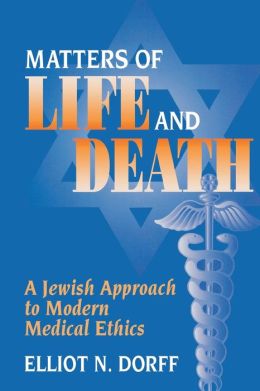
Last night he spoke about his book Matters of Life and Death: A Jewish Approach to Modern Medical Ethics.  
He presented an interesting argument.  There are some authorities who believe that there is nothing new under the sun and for every contemporary issue that arises there are traditional Jewish sources that address the issue.  Whether it be organ donation, stem cell research, human cloning, or space travel, one need only look carefully at the ancient sources of the Torah, Talmud, and codes and one will find that the ancients offered us guidance on all of these issues.  

Rabbi Dorff rejects this assumption.  Whereas he does acknowledge that the ancients did have the wisdom to address a great number of timeless issues, they could not even imagine most of the issues and moral dilemmas presented by modern scientific discoveries and technological advancements.  If they could not imagine these issues, then their writings can offer us no guidance on these matters.  So rather than search the ancient sources for specific precedent for contemporary issues, in modern times we should be guided only by general core Jewish principles and values when making decisions.

I have not read his book yet so it was not completely clear to me whether there are practical differences between the way he would address a particular issue versus the way that an Orthodox medical ethicist would address the same issue.  

On the way to the airport I asked him if he had ever participated in a public conversation with an Orthodox counterpart.  He said that he had not.  It would be great if a forum like the 92nd street Y would organize such an event.  If anyone out there works for 92Y see if you can make that happen!

Although he spoke last night at the Conservative Synagogue, he was brought to Omaha by the ADL to address non-Jewish audiences on Sunday and Monday.  

I have always found it interesting that the non-Jewish world generally looks to non-Orthodox thinkers for guidance on Jewish ethics.  The shelves of Barnes and Noble mostly feature the works of non-Orthodox writers who skillfully articulate their message for the masses.  

Which leading Orthodox Rabbis have authored books that have been best sellers or that are viewed as universally relevant (other than Shmuley Boteach)?  When was the last time that a Rosh Yeshiva from Yeshiva University or Lakewood was asked to address the AMA about medical ethics?  There are a few Rabbis who are regarded outside the Orthodox world as experts - Rabbis J. D. Bleich and Michael Broyde come to mind - but they are exceptions, not the rule.   

That is not to say that Orthodox Rabbis have nothing to say about contemporary issues.  On the contrary, they have much to say:
  • volumes and volumes have been written on wide range of subjects, probably much more so than by Conservative and Reform writers. 
  • Orthodox shuls and institutions regularly feature lectures on contemporary topics. 
  • Rabbi Moshe Feinstein, considered by Orthodox Jews to be the 20th century's greatest decider of Jewish law, wrote extensively on a host of contemporary issues, and 30 years after his death Orthodox scientists and doctors still consider his works as informed, insightful, and authoritative.    
But somehow the impact is not felt by the non-Orthodox Jewish community, and certainly not by the non-Jewish community.
Granted, most serious Orthodox works on medical ethics are written in Hebrew, but if these works had the potential to make an impact they would quickly be translated into English.

There are several reasons that I think Orthodox medical ethics do not make an impact.

  • Orthodox authors deal with issues and problems that are presented by modern advances in medicine, but many of these "issues" and "problems" are only relevant if the doctor or patient is an Orthodox Jew.  There is extensive literature on issues like whether or not a particular procedure can be performed on Shabbat or whether certain medications are kosher for passover and other such ritual conflicts that are not apparently relevant to the masses.
  • Many positions taken by modern authorities are predicated on the opinions of ancient authorities who lived hundreds, sometimes thousands of years ago.  While these ancient positions are binding to an Orthodox Jew, a non-Orthodox Jew and certainly a non-Jew has a hard time understanding how the answer to a question can come from someone who lived centuries before the question was even asked.
  • And finally, many Orthodox ethicists express their positions on issues as if they were based ONLY on Scriptural or Talmudic sources without providing a compelling logical or moral basis.  
To be clear: whenever I am presented by my congregants with ethical dilemmas presented by modern medicine -which is not so uncommon unfortunately - I immediately turn to the Orthodox Rabbinic authorities who I know and trust. I happen to know quite a few who despite the many demands on their time make themselves readily available to community Rabbis like me and my colleagues throughout the country.

These Rabbinic authorities that I have consulted with in the past are completely knowledgeable on any given medical issue.  Often they are more knowledgeable then the doctor that I am dealing with simply because these expert Rabbis often have more experience with the rare morally complicated cases and the Rabbis are usually more up to date on the literature pertaining to these ethical issues than most doctors are.  Doctors are skilled in the procedures but in many instances they have not taken the time to think through the greater consequences to certain actions the way that these expert Rabbis have.

In actual cases these authorities weigh every issue independently and take into account as many facts and variables as it is possible to account for in real time.  In the many times that I have had to consult, I never felt that a Rabbinic authority provided me with an answer that was not informed, rational, logical, and based in a morality that was easily understandable.  I have the greatest respect for the Orthodox Rabbinic authorities.

That is exactly why I want them to make a greater contribution to general society.  I do believe that the Torah offers valuable insight that is completely relevant to contemporary problems and that the world would benefit a great deal if Orthodox experts on medical ethics would make the wisdom of the Torah available and accessible through articulate writings that make the underlying morality of Jewish law more apparent.

But as Pharoah said, "Could we find a man like this in whom is the spirit of God?"